
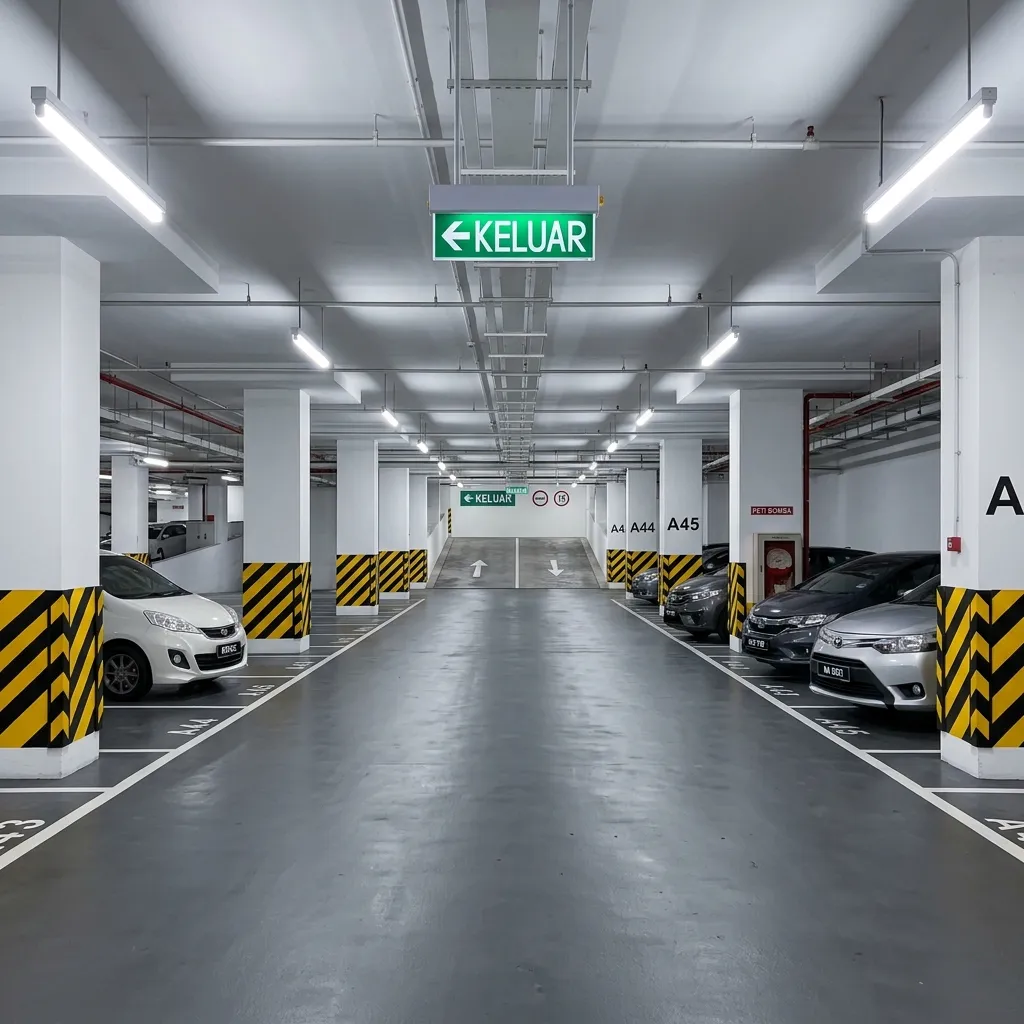
To reduce the electricity bill of a commercial building in Malaysia, start with loads that run at full power while nobody is using them. Carpark and back-of-house lighting is that load. At The Glenz at Glenmarie, radar LED lighting cut carpark lighting energy by about 80 percent and the whole common electricity bill by about 20 percent, with RM 0.00 upfront. Chillers still matter. They are not the first cheque if the lamps never rest.
The bill owners and facility managers actually argue about
Commercial electricity in Malaysia is a monthly argument between the TNB invoice, the ICPT adjustment on that invoice, and the people who have to explain it. Office landlords hear it from tenants. Mall operators hear it from retailers. Hotel engineers hear it from the owner’s report. Hospital and factory teams hear it as a cost that does not wait for a capital budget. Mixed developments hear it once, on a common meter that nobody feels they control.
Lighting is the load in view. A wider list, including chiller tuning and lift regeneration, is already written as three strategies for commercial electricity bills. Lighting is singled out because it is the strategy with a Malaysian whole-bill result on record, and because it does not ask the building to fund the work before the saving starts.
Commercial owners and facility managers are the audience. On a mixed development, use the common commercial meter and the commercial carpark as the scope.
Why lighting is a bill problem even after an LED swap
Air conditioning dominates the afternoon peak. It does not dominate every hour. From late evening to early morning, and across long stretches of a weekend in an office, the chiller is already set back and the carpark lights are not. A basement has no daylight to take over. The circuit is closed for safety, and the lamps do what they were wired to do: stay on.
Legacy T8 fluorescent tubes in the Glenz baseline drew 36W each, continuously, across more than 1,000 fittings. A first-generation LED at 18W to 24W, left at 100 percent, is a better lamp and still a 24-hour load. Unmanaged carpark lighting can reach 30 to 40 percent of common-area electricity. Treat that as a planning range, not as a survey of your building. The way to know your number is to read your bill and count the lamps that never dim.
Commercial tariffs make those empty hours expensive in a simple way. You pay for kilowatt-hours whether a customer, a patient or a worker is under the lamp. ICPT moves the effective rate over time, which is why a load that cannot be switched with occupancy becomes a standing grievance. The basement-bill guide already walks through why 24/7 carpark lighting hurts under commercial TNB charging: why basement carpark bills stay high.
The lighting move that showed up on a whole-building bill
The Glenz at Glenmarie is the measurement. Radar-controlled LED nodes replaced always-on fluorescent lighting in the basement. Carpark lighting energy fell by about 80 percent. The development’s entire common electricity bill fell by about 20 percent. Upfront capital was RM 0.00.
Read that second figure carefully. It is not “80 percent off the TNB bill.” It is a lighting project large enough, on that site, to move the whole common bill by about a fifth. Buildings whose carpark is a smaller share of the meter will see a smaller whole-bill move from the same lighting percentage. Buildings whose carpark is a larger share can see more. The assessment exists so you do not borrow The Glenz percentages as if they were your invoice.
The hardware that produced the cut is not complicated to describe. 5.8GHz radar, not PIR. Standby at about 20 percent illuminance and about 4W to 5W. Full output at 16W only on the path in use. A mesh so the lights rise before the vehicle, not after someone has already driven into a dim bay. Tubes that fit existing T8 holders, so the saving does not wait on a rewire. The product page for that behaviour is smart carpark lighting for commercial buildings.
What not to do if the goal is the bill
Do not buy lamps that cannot dim with occupancy. You will pay for a retrofit and keep the empty-hour load.
Do not use PIR as the control layer in a basement. Warm air, windscreens and pillars make PIR late or blind. Teams then force the lights on, and the bill returns. The sensor comparison is radar versus PIR.
Do not turn the carpark off. A commercial building that goes dark loses CCTV quality and gets safety complaints. Standby at 20 percent keeps the floor lit, no longer at 36W.
Do not wait for a capital window if the model on offer is Zero CAPEX. Hardware, delivery and installation at RM 0.00 upfront means the bill can change without a reserve draw. The fee is funded from the savings. Failures during the contract are replaced when the cloud sees them, so maintenance callouts do not become a second project. See the financial case.
Do not ignore the rest of the building forever. Once lighting is on a measured standby, chiller and ventilation work is still legitimate. It is just a worse first project if you needed a saving this quarter without shutting plant down.
How a facility manager builds the case
Use three months of common-area bills and a rough lamp count. Separate the claim the way The Glenz is reported: lighting energy, then the whole common bill. Engineering should only speak to the second figure after seeing how large lighting is on that meter. The six-step assessment starts that arithmetic. An on-site audit in Greater Kuala Lumpur and Selangor is described as three business days.
ESG teams can use the same project. The kilowatt-hours no longer purchased are Scope 2. The ESG decision guide connects the Glenz bill cut to GreenRE, GBI and Bursa evidence. If the board asked for a lower bill and the sustainability report asked for proof, it is one retrofit, not two budgets.
Estimate your lighting savings Read the ESG decision guide