
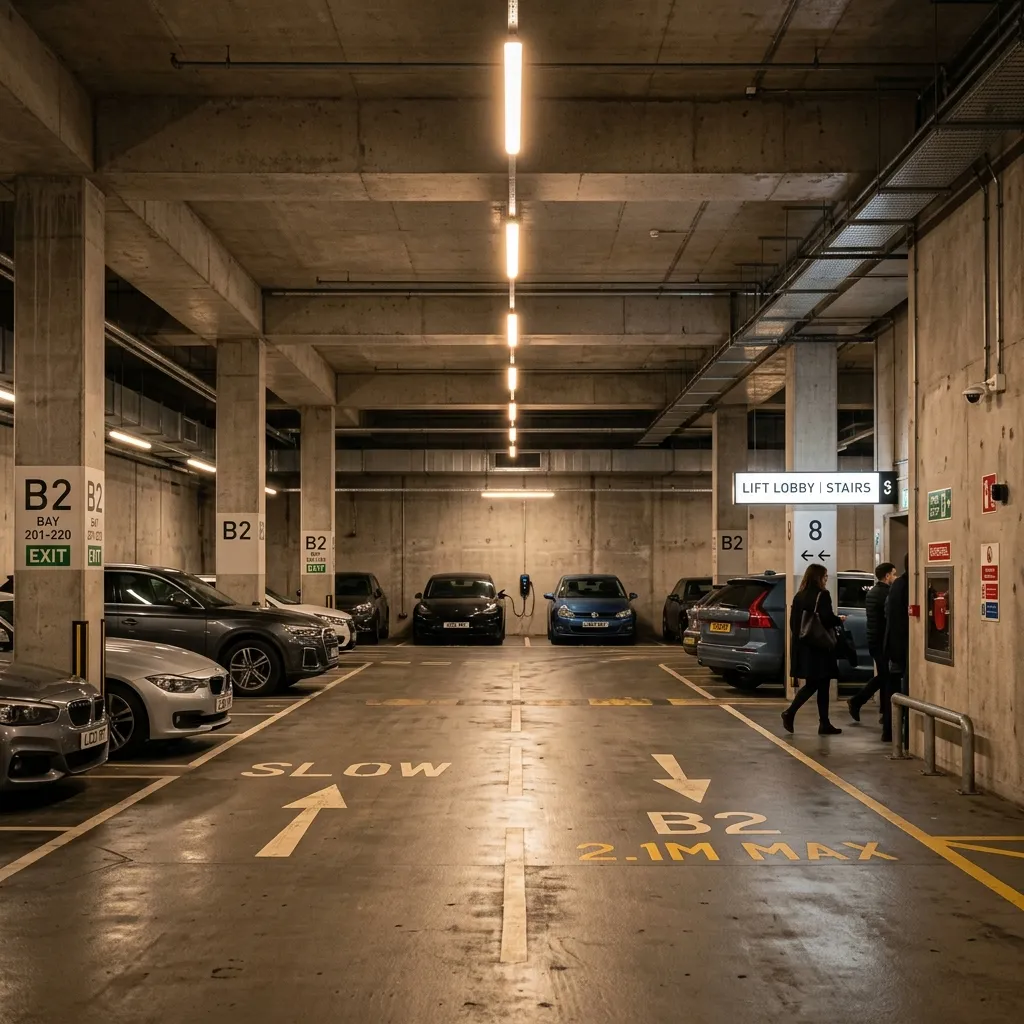
Malaysian Commercial Building Benchmark: While basement carparks operate 24/7, parking bays remain vacant over 80% of the time. For verified data on how The Glenz cut carpark lighting power by ~80% and total building common electricity bills by ~20% without sinking fund expenditure, see our primary guide: ESG Decision Guide (Glenz-Proven): Zero CAPEX & Carpark Lighting Compliance.
The Hidden Drain in Your Commercial Property
When commercial owners and facility managers analyze their monthly utility bills, they understandably focus on the high-visibility culprits: chiller plants, massive air conditioning units, and peak-hour elevator usage. These systems are loud, obvious, and draw massive amounts of power.
However, one of the largest, most persistent, and most unnecessary drains on your operational expenditure (OPEX) is often hidden below ground, completely out of sight: the basement carpark lighting.
Unlike office spaces where lights are turned off at 6:00 PM, or retail corridors where lighting is optimized for operating hours, the basement carpark is a different beast entirely. Because it is subterranean and lacks natural sunlight, safety and security regulations mandate that it must remain illuminated at all times.
The Staggering Math Behind 24/7 Lighting Wastage
Let’s look at the harsh mathematical reality of 24/7/365 illumination.
If your building was constructed more than 5 years ago, there is a high probability you are still using traditional T8 fluorescent tubes. These tubes typically consume 36W of power, but when you factor in the inefficient magnetic ballast, the actual draw is closer to 40W per fixture.
Even if the building recently approved an "eco-upgrade" to first-generation standard LED tubes (which typically draw 18W to 24W), the fundamental problem remains: The lights are always on at 100% brightness.
Consider a standard commercial integrated development in Malaysia with a three-level basement carpark housing 3,000 light tubes.
If you are using 18W standard LEDs:
- 3,000 tubes × 18W = 54,000W (54 kW) per hour.
- 54 kW × 24 hours = 1,296 kWh per day.
- 1,296 kWh × 365 days = 473,040 kWh per year.
At a commercial tariff rate of RM 0.45 per kWh (excluding ICPT surcharges), you are paying RM 212,868 every single year just to keep the carpark lit.
But here is the critical flaw in this setup: For the vast majority of the day—especially between midnight and 7:00 AM, and often during mid-morning lulls—the carpark is completely empty. You are paying over RM 200,000 a year to brightly illuminate empty concrete bays and parked, unoccupied cars.
The Failed Solution: Timers and PIR Sensors
Historically, facility managers have tried two methods to curb this wastage, and both have failed spectacularly.
1. Timers and Alternate Switching: Some buildings attempt to wire their lights on alternating circuits, turning off half the lights during off-peak hours. This creates a "checkerboard" of dark spots, which violates safety codes, terrifies tenants, and dramatically increases the risk of accidents and theft.
2. Legacy PIR (Passive Infrared) Sensors: PIR sensors detect heat motion. While they work in small office pantries, they fail in large carparks. They cannot see through concrete pillars or glass windows. A driver often has to drive directly underneath the sensor to trigger it, resulting in a terrifying driving experience where the car is constantly plunging into darkness before the next light triggers. Furthermore, in Malaysia’s hot climate, ambient heat often causes PIR sensors to malfunction, staying on permanently or failing to trigger at all.
The Paradigm Shift: Intelligent, On-Demand Illumination
The solution is not turning off the lights. The solution is providing 100% illumination only when needed, and dropping to a safe, low-power state when the area is empty.
This requires a shift from "dumb" LED tubes to an intelligent, IoT-driven lighting network powered by Microwave Radar.
Here is how the MindVox smart lighting system fundamentally solves the high electricity bill problem without compromising safety:
The 20% Standby Mode
Instead of operating at full brightness, MindVox smart IoT lights idle at a safe 20% brightness level when a zone is vacant. At 20% brightness, the tube consumes a mere 4W to 5W of power. The carpark remains safely lit—no dark, scary corners—but the energy draw is slashed by nearly 80%.
Predictive, Obstacle-Penetrating Radar
MindVox utilizes 5.8GHz microwave radar embedded directly into the LED tube. Unlike PIR, microwave radar emits a high-frequency wave that can penetrate glass and bounce around concrete pillars. It detects the physical mass of a moving vehicle long before it enters the direct line of sight.
The Wireless Mesh "Wave of Light"
What truly sets the system apart is the wireless mesh network. When one tube's radar detects a vehicle, it instantly sends a wireless signal to the adjacent tubes. The lights ramp up from 20% to 100% brightness ahead of the driver. This creates a seamless "wave of light" that provides a premium, ultra-safe experience for the occupant.
The Financial Impact: Cutting the Bill by 80%
Because a typical carpark is only actively occupied by moving vehicles or pedestrians for 15% to 20% of a 24-hour cycle, the MindVox lights spend roughly 80% of their life in the 5W standby mode.
Returning to our previous example of 3,000 tubes: Instead of consuming 473,040 kWh per year, the dynamic MindVox system drops the consumption to roughly 85,000 kWh per year.
Your annual bill drops from RM 212,868 down to roughly RM 38,000.
You save over RM 174,000 every single year—slashing carpark lighting power by ~80%. In benchmark implementations such as The Glenz at Glenmarie, this translated into an immediate ~20% reduction in the total common property electricity bill, with zero upfront capital outlay.
Stop Paying for Empty Spaces
If your building's operational budget is being squeezed by rising ICPT surcharges and general inflation, you cannot afford to ignore the basement. Every night that your standard LEDs burn at 100% brightness in an empty carpark, you are burning operating cash that a commercial owner could have kept.
It is time to upgrade to a system that works as smartly as the rest of your modern building infrastructure. Stop paying to illuminate empty spaces, and start redirecting those massive savings toward the betterment of your property.
Eliminate 24/7 Carpark Energy Wastage
Stop subsidizing empty parking bays. Discover how to transition your building to intelligent microwave radar lighting under a cash-flow-positive structure:
👉 Read the commercial ESG decision guide or estimate your lighting savings.