
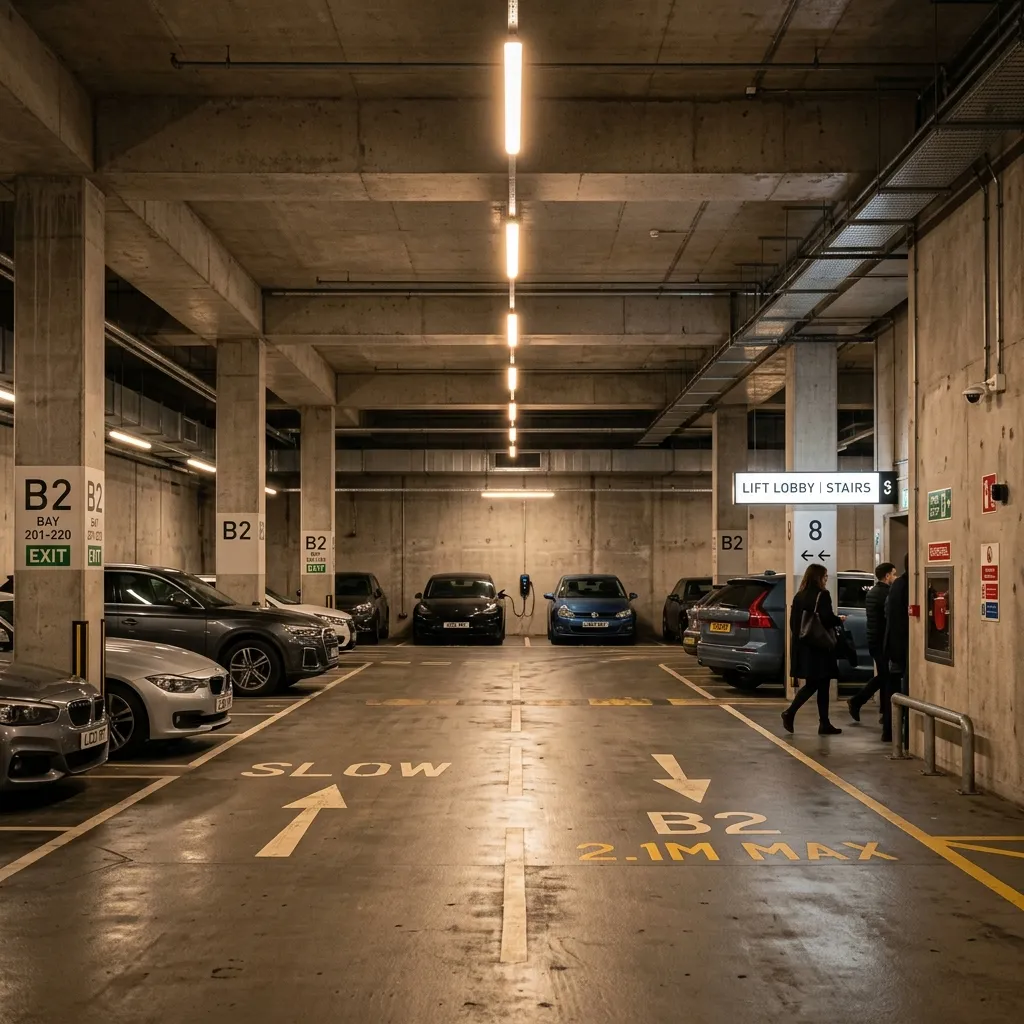
Smart carpark lighting for a commercial building in Malaysia means 5.8GHz radar LED tubes, not PIR, holding a safe 20 percent standby at about 4W to 5W and lifting to full light along the vehicle path. The Glenz at Glenmarie used that pattern to cut carpark lighting energy by about 80 percent and the whole-building common bill by about 20 percent, at RM 0.00 upfront. The point of the system is empty hours, not a brighter brochure lamp.
Commercial carparks waste power in a particular way
An office carpark empties after six and sits through the night. A mall deck is sparse after closing. Hotels, hospitals and factories move in bursts, then go quiet. A mixed development does several of these at once.
What they share is a lighting circuit that was designed as if the peak hour lasted all day. Fluorescent tubes at 36W, or LEDs left at full output, do not know the difference between a full floor and an empty one. Over a month, the empty hours are the majority of the hours. That is the energy a smart carpark system is supposed to stop buying.
Owners and facility managers of those buildings are the people who specify the system. A basement that serves a commercial podium is in scope when a commercial team operates it. The proof case, The Glenz at Glenmarie, is an integrated commercial development in Selangor.
What “smart” has to mean, or the word is useless
A tube with a timer is not enough, because commercial arrivals are not a single office schedule. A hotel and a hospital do not go quiet at 7 p.m. A tube with a cheap PIR sensor is the version many buildings already regret. PIR needs a heat change in a direct line of sight. Malaysian basements are warm, full of concrete, and full of windscreens. The sensor misses the driver, the light drops mid-ramp, and operations bypass the sensor. You are back to 24/7 full output, plus a failed device to maintain.
MindVox smart carpark lighting uses 5.8GHz microwave radar in the tube. It detects vehicles and people through glass and past non-metallic obstacles, from about 8 to 10 metres, and it is filtered so rats and stray cats do not count as traffic. Detection is not only local. The mesh tells the fittings ahead to come up to 100 percent before the car gets there. That is the wave of light. Behind the vehicle, once the zone is empty again, the tubes return to standby.
Standby is about 20 percent illuminance and about 4W to 5W. It is not darkness. CCTV keeps a colour image at that level, which matters in a mall, a hotel porte-cochère approach, and a hospital staff deck. Full brightness on the tube is 16W. Compared with a 36W fluorescent lamp that never rests, both the on-state and the off-peak state are lower, and the off-peak state is where the hours are.
Energy saving, tied to a real building
“Carpark lighting energy saving” is a crowded phrase. The measured pair on record is The Glenz. More than 1,000 fluorescent tubes ran at 36W, continuously. After the radar LED retrofit, carpark lighting energy fell by about 80 percent. The development’s entire common electricity bill fell by about 20 percent. Those are lighting results showing up on a whole-building bill, which is the comparison a facility manager can defend. They are not a quote for your building. Your bill, your hours and your tariff decide the ringgit. The six-step assessment starts the conversation from your figures.
The mechanism that makes an 80 percent lighting cut plausible is the standby duty cycle, not a magical lamp. If a commercial floor is only busy in peaks, and the lamp spends the rest of the day at 4W to 5W instead of 36W, the monthly kilowatt-hours collapse. A lamp that is efficient but always at 100 percent cannot do that. This is also why a LED retrofit that only changes the lamp type under-delivers, and why the control method has to be in the specification.
Safety objections facility teams actually raise
“We cannot dim a public carpark.” The system does not switch the floor off. Twenty percent is held all the time. The full level meets the moving car, not the other way around.
“CCTV will be useless.” Colour night images and recognition still work at the 20 percent standby. If a particular camera was already marginal on fluorescent light, that is an audit finding to resolve on site.
“Sensors will nuisance-trip.” Mass filtering is part of the 5.8GHz controller. Small animals are rejected so the floor does not leave standby every time a cat crosses a bay.
“Drivers will enter a dark ramp.” Because the mesh fires ahead of the vehicle, the ramp is the first place the wave should be visible. That is a commissioning check, and it is why radar range (about 8 to 10 metres) is a specification item rather than a slogan.
“Installation will block bays for a week.” The method is T8 plug-and-play, zone by zone, on the existing wiring, during ordinary hours. No new conduit is required.
The energy-saving model without a capital project
Commercial facility budgets are operating budgets. A smart lighting project that arrives as a capital request competes with chillers and lifts and usually loses. Zero CAPEX means the tubes, the gateway and the installation are RM 0.00 upfront. The monthly service is funded from the electricity savings, and failed hardware is replaced under the contract when the cloud flags it. Reserves are not the cheque. The ESG decision guide puts the Glenz numbers next to the GreenRE, GBI and Bursa evidence trail. The bill page stays on the TNB side of the same project.
Hardware behaviour, the gateway, and the local-plus-cloud layout are on the features page. A comparison written only about the sensor choice is radar versus PIR.
Bring a lamp count, the common-area bill, and a note of any PIR gear already bypassed. Greater Kuala Lumpur and Selangor audits are a three-business-day site visit, then a written proposal. The Glenz figures are the benchmark, not a price list and not a guaranteed percentage for a building that has not been surveyed.
Estimate your lighting savings Read the ESG decision guide