
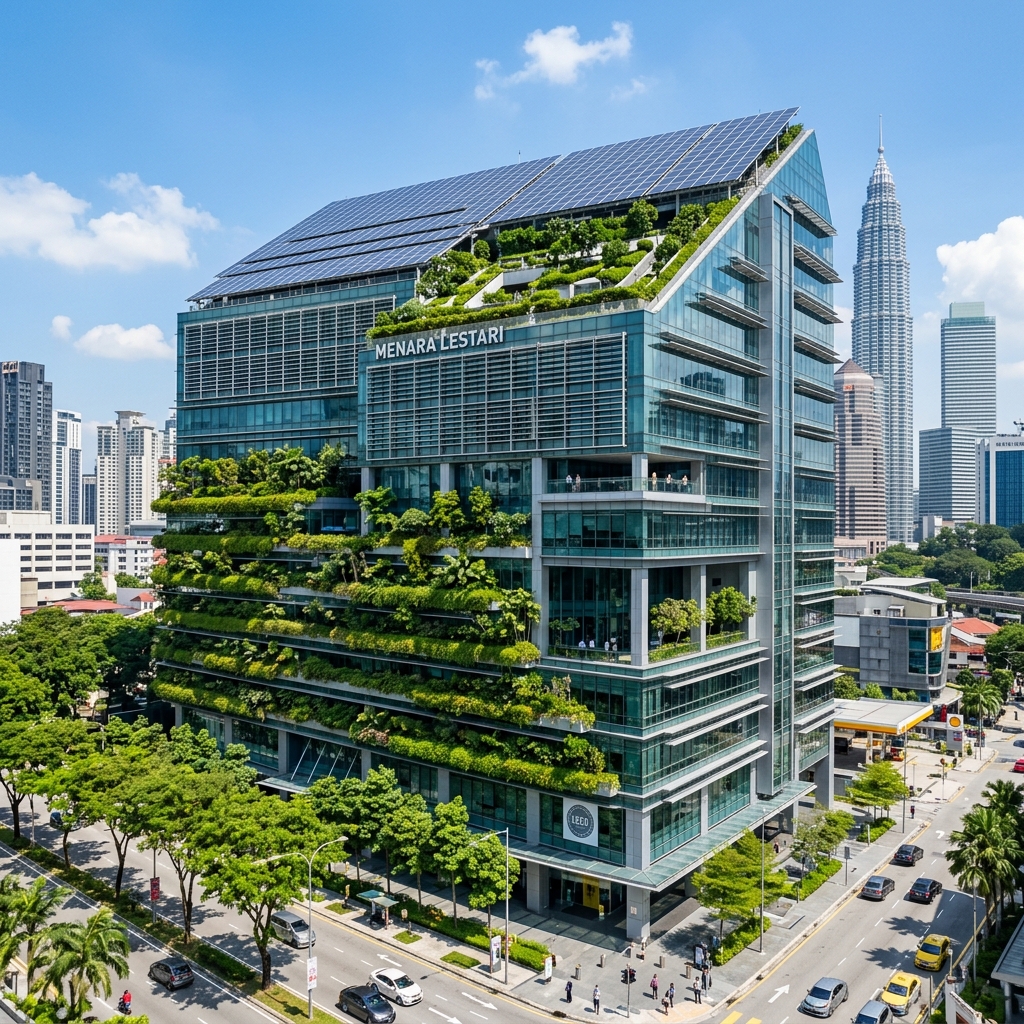
Scoring & Verification Reference: While practical credit points are detailed below, authoritative compliance documentation, empirical verification from The Glenz at Glenmarie, and turnkey JMB contract frameworks are consolidated in our primary guide: ESG Decision Guide (Glenz-Proven): Zero CAPEX & Carpark Lighting Compliance.
1. Direct Energy Efficiency Credits: By replacing continuous 36W fluorescent tubes with 5.8GHz radar smart LEDs that idle at 20% brightness (~4W-5W), commercial buildings cut carpark lighting electricity by ~80%, directly qualifying for GreenRE Non-Residential Part 1 (EE 1.0 & EE 3.0) and GBI Energy Efficiency (EE1 & EE4) credits.
2. Auditable Scope 2 Telemetry: Embedded microprocessors log real-time kilowatt-hour (kWh) and carbon reductions, generating third-party verifiable data logs required for Bursa Malaysia ESG disclosures without manual estimates.
3. Zero CAPEX Implementation: Malaysian JMBs deploy these upgrades with RM 0.00 upfront from sinking funds. The contract is 100% vendor-financed and repaid strictly through verified monthly utility savings (~20% common electricity bill reduction at The Glenz).
The Shift from Intent to Verification
In the world of Environmental, Social, and Governance (ESG) reporting, good intentions and vague corporate sustainability statements are no longer enough. Institutional investors, regulatory bodies, and premium tenants now demand empirical, verifiable data.
In Malaysia, this shift is accelerating rapidly. Bursa Malaysia has enhanced its sustainability reporting framework, requiring Main Market listed issuers to provide specific, quantifiable climate-related disclosures aligned with the Task Force on Climate-related Financial Disclosures (TCFD). This has placed immense pressure on building owners and Real Estate Investment Trusts (REITs) to not only implement green technologies but to accurately track, verify, and report their impact.
Major Scoring Frameworks in Real Estate
To prove sustainability, buildings rely on established green certification frameworks. In Malaysia, the most prominent are:
- GreenRE (Green Real Estate): Developed by REHDA, highly tailored to the tropical climate and heavily adopted by Malaysian developers.
- GBI (Green Building Index): Malaysia's recognized green rating tool for buildings and towns.
- LEED (Leadership in Energy and Environmental Design): The globally recognized standard.
- GRESB (Global Real Estate Sustainability Benchmark): The global ESG benchmark for financial markets and institutional investors.
Regardless of which framework your property is aiming for, Energy Efficiency remains one of the most heavily weighted categories. Carpark lighting, which traditionally runs 24/7/365, is a prime target for optimization. But how do smart lights specifically translate into tangible points for your ESG score?
1. Tangible Energy Reduction Points (The Heaviest Weight)
Most green building frameworks award points on a sliding scale based on the percentage of energy reduced compared to a baseline standard (often ASHRAE 90.1 or MS 1525 in Malaysia). The more you reduce, the more points you score.
Because MindVox's IoT smart parking lights utilize a predictive microwave radar network, they dim to 20% brightness (~4W-5W ultra-low standby) when areas are vacant. This results in an immediate ~80% reduction in carpark lighting energy consumption (and a ~20% cut in overall common property electric bills, as proven in real installations like The Glenz at Glenmarie).
This massive drop often maxes out the available points for the lighting efficiency sub-categories. For example, in GreenRE for existing non-residential buildings, significant points are allocated for achieving lower Lighting Power Budgets (W/m2) and implementing advanced controls. By slashing your carpark's energy draw by 80%, you instantly secure these critical points, moving your building closer to a Gold or Platinum rating.
2. Verifiable Data & Airtight Audit Trails
The biggest challenge in modern ESG reporting is proving your savings. Traditional LED upgrades often rely on "calculated estimates"—you replace a 36W tube with an 18W tube, multiply by 24 hours, and claim the difference. However, strict auditors increasingly scrutinize estimated data.
MindVox changes this paradigm by turning your lighting infrastructure into a distributed IoT sensor network. Our edge gateways communicate with the microprocessors in every single light tube. The system provides real-time, quantifiable data on:
- Actual kilowatt-hours (kWh) consumed.
- Actual kilowatt-hours (kWh) saved versus the baseline.
- Motion triggers and occupancy heatmaps.
This data is aggregated into a secure, localized dashboard. When it is time for an ESG audit or compiling your annual sustainability report, you do not provide estimates; you export hard, empirical data logs. This creates an airtight audit trail that ESG assessors love, fulfilling the strict Governance (G) requirements of modern reporting.
3. Points for Innovation and Smart Controls
Frameworks like LEED and GreenRE have specific, dedicated credits for "Innovation" and "Advanced Lighting Controls." They actively reward buildings that go beyond basic retrofits and implement cutting-edge technology.
Basic PIR motion sensors might earn minor control points, but implementing a decentralized, AI-driven wireless mesh network that reacts predictively to vehicles qualifies for maximum advanced technology credits.
For instance, LEED v4.1 O+M (Operations and Maintenance) awards points for advanced energy metering and optimized energy performance. GreenRE awards points for the use of smart facility management systems. MindVox's predictive illumination and data harvesting capabilities slot perfectly into these innovation categories, providing those crucial extra points that can push a building into a higher certification tier.
The Tenant Factor: The Commercial Value of ESG
Why go through the trouble of securing a high GreenRE or GBI score? Beyond regulatory compliance, it is about commercial viability.
Multinational Corporations (MNCs) and premium tenants now have their own strict corporate ESG mandates. When they lease office space, they are mandated to choose buildings with high green certifications to lower their own Scope 3 emissions (value chain emissions). A high ESG score makes your building a magnet for high-paying, long-term premium tenants. Conversely, "brown" buildings with poor energy efficiency are facing a "brown discount," suffering from lower occupancy rates and reduced asset valuation.
Conclusion
Upgrading to smart IoT lighting is not just a facilities management decision to save on the monthly TNB bill; it is a strategic corporate move. It turns a static, energy-draining building asset into a dynamic data generator. By slashing energy usage and providing verifiable audit trails, MindVox directly boosts your ESG score across GreenRE, GBI, and GRESB, ultimately increasing your asset valuation and securing the long-term commercial success of your property in a green-focused future.
Frequently Asked Questions: GreenRE & GBI Lighting Credits
Institutional ESG Decision Framework
Equip your building committee with verified Scope 2 telemetry, turnkey Zero CAPEX financing, and empirical case evidence:
👉 Explore the ESG Decision Guide (Glenz-Proven) — Zero CAPEX & ESG for JMBs